Perhaps you’ve gone to pick up something off the floor and you feel that your hamstrings are a little tight. Maybe, in a flash of inspiration you decide to get up and go on a jog for the first time in 10 years and you feel a strain coming on. These are relatively common ailments that plague weekend warriors and your average 9-5er alike. Building hamstrings that can handle the stresses of life doesn’t mean they will always feel “loose” or that strains never happen but you can certainly train them to be Stronger For Life. In this article, we’ll discuss how. To begin with we’ll address anatomy, then useful exercises and finish with a blueprint.
Hamstring Anatomy
Fear not, you won’t need your copy of Grey’s Anatomy for this one. Three distinct muscles make up the hamstrings. They are the biceps femoris, the semitendinosus and semimembranosus which are located on the back of the thigh, crossing both the hip and knee joint. They all extend the hip and flex the knee, with some exceptions. The biceps femoris, which is made up of a long and short head, helps to rotate your lower leg from side-to-side when your knee is bent. The short head is the only hamstrings muscle that does not cross the hip joint. The semitendinosus and semimembranosus also help to rotate the hip. Anatomy dictates function and therefore, training protocols. Hip-dominant exercises seem to stimulate greater hypertrophy in the biceps femoris long head and semimembranosus. Knee-dominant exercises like the Nordic hamstring exercise preferentially develop the semitendinosus and biceps femoris short head ¹ .

Hamstring Exercises
Hamstring training can be split into two categories: knee flexion and hip extension. Distal subdivisions (closer to the knee) experience the highest mechanical tension during knee flexion. The lateral and proximal hamstring (closer to the hip) experiences high levels of tension during hip extension ². Therefore it is complimentary rather than redundant to train both movements. Exercise selection is remarkably simple, as follows:
Knee Flexion Exercises:
- Nordic Hamstring Curls
- Lying Leg Curls
- Seated Leg Curls
- Bridge Curls
Hip Extension Exercises:
- Romanian Deadlifts
- Hip Thrusts
- Deadlifts
Lastly, special attention can be given to hamstring strains and sport. Although a broader discussion is outside the scope of this article, it’s worth mentioning that research shows some benefit to specific exercises such as the Nordic hamstring curl with an emphasis on the eccentric or lowering portion. For athletes across various sports, consistently training this movement seems to be protective. This movement develops the biceps fermoris long head fascicles which is thought to reduce the chance of strain while sprinting, especially when the hamstrings decelerate the leg straightening out ³. However, consistency with strength training, reducing the asymmetry between left and right hamstring muscles and including core and agility training also seems to reduce risk of strain.
The hamstring blueprint
The American College of Sports Medicine 2026 Physical Activity Guidelines recommend training all major muscle groups at least twice weekly ⁴. Therefore, one slot of hip extension exercise such as the Romanian Deadlift, and one slot of a knee flexion exercise such as the Seated Leg Curl is sufficient. Let’s look at an example of a standard 2-Day Split:
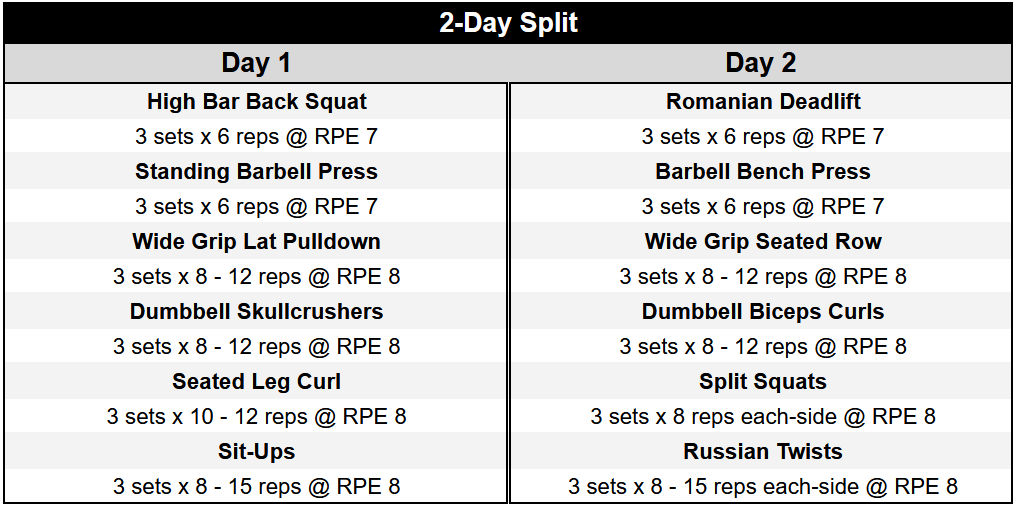
Example of a 2-Day Split where two slots a week are dedicated towards training different components of the hamstrings.
There is no need to repeat the same exercises forever. Romanian Deadlifts can be swapped out for Conventional Deadlifts and Seated Leg Curls for Nordic Hamstring Curls and so on. Other modifiable variables include tempos, pauses, rep-ranges and proximity to failure. Variety, employed intelligently over time is a powerful tool. Progressive loading is essential to increasing strength and muscle mass. Simply put, if the weight moved for deadlifts and leg curls increases over time, your hamstrings are likely getting stronger and increasing in muscle size when paired with sufficient recovery and nutrition.
Sydney Strength Training offers expert coaching and guidance for all things strength, fitness and longevity. If you’re looking to be Stronger For Life, strong hamstrings are a must. Contact us today and get started.